
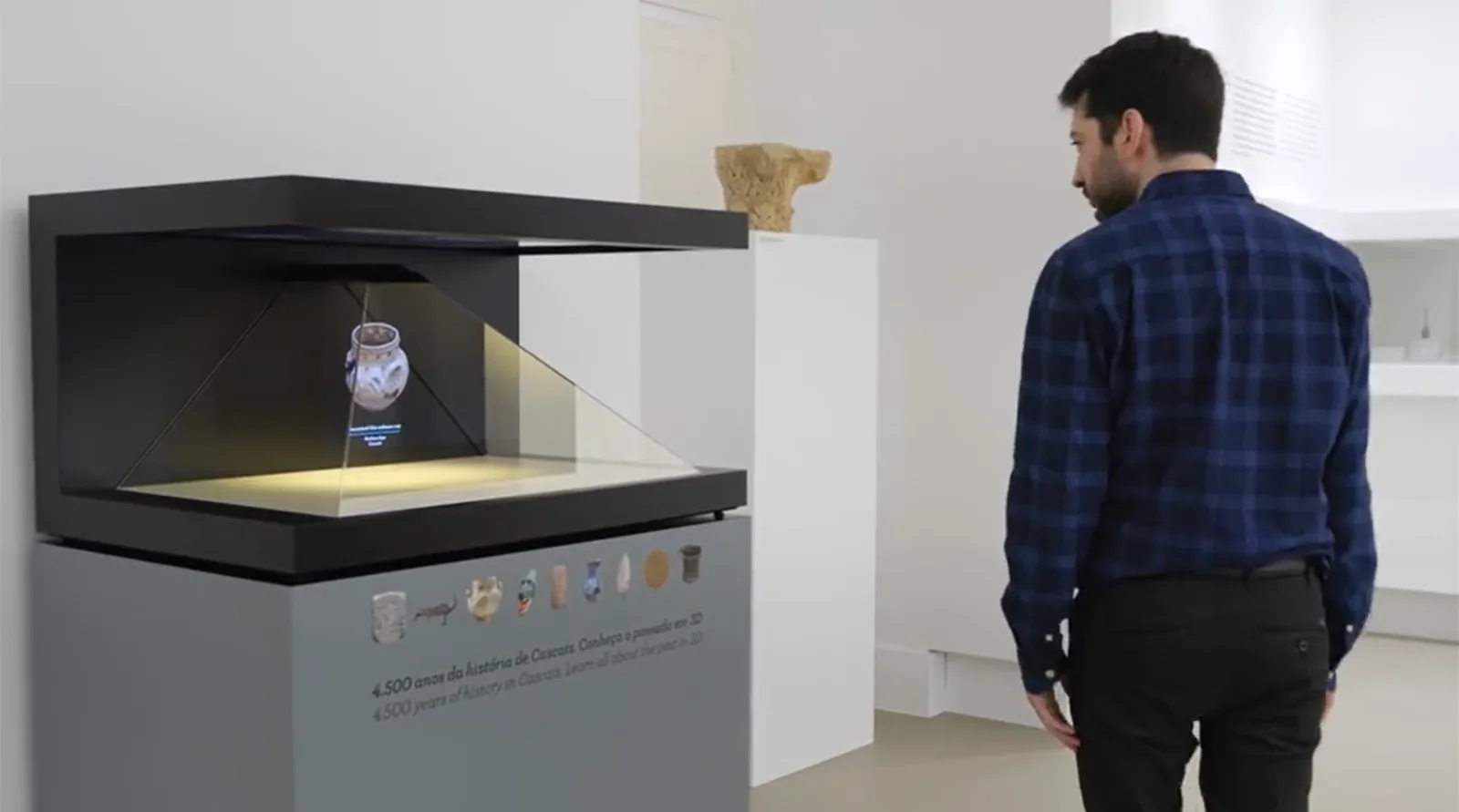
Innovation is not measured in screens
Walk into a newly modernized museum and there is a good chance you will find screens.
Touchscreens beside objects. Large displays on walls. Digital information points. QR codes leading to more digital content.
None of these things are inherently bad. But installing technology is not the same as creating an interactive experience.
At We Are Interactive, we often see museums approach innovation from the technology side first. There is an understandable desire to make a space feel contemporary, and visible technology can seem like the clearest way to demonstrate that change.
The problem is that visitors do not experience a museum as a list of technical specifications.
They experience what they can see, hear, touch, discover and remember.
“In our perspective, acquiring and installing screens, per se, should not be the purpose or the concept of innovation”
Eduardo — We Are Interactive
The more useful question is not, “What technology can we add?”
It is, “What should happen here?”
Why another touchscreen can feel surprisingly ordinary
Touchscreens are useful tools. For detailed information, menus, maps and precise selection, they can be exactly the right interface.
But familiarity can also work against them.
Visitors already spend a large part of everyday life looking at and touching screens. They scroll on phones, use computers, order from digital kiosks and navigate apps.
Then they enter a museum and are sometimes asked to do essentially the same thing again.
“In many places you see a lot of touchscreens, which is counterproductive because people are using touchscreens every day Then you go to a museum and you have a bunch more screens to scroll through information.”
Eduardo — We Are Interactive
A museum has something most digital products do not: a physical environment filled with objects, architecture, sound, history and space.
Interactive design can use all of it.
The opportunity is not simply to digitize the museum. It is to make the museum itself more responsive and engaging.
Start with what the museum is actually about
When Eduardo is asked what his first question would be if a museum said, “We want something interactive,” his answer is immediate:
“What’s your museum about?”
That question sounds simple, but it changes the direction of the project.
Before deciding whether an installation needs projection, LiDAR, audio, sensors, screens or anything else, the team needs to understand the subject of the museum, the content visitors should encounter and the people the experience is designed for.
Who is the audience?
What should they learn?
What should they notice?
What should they physically do?
What should stay with them after they leave?
Once those questions have answers, technology becomes a design tool rather than the concept itself.
This is the approach We Are Interactive takes to museum and exhibition experiences. Define the visitor experience first. Then work backwards to the technology that can make it happen.
The most interesting technology might be the simplest
One of the areas Eduardo believes museums underuse is not a particular new device at all.
It is the ability to make existing physical objects interactive.
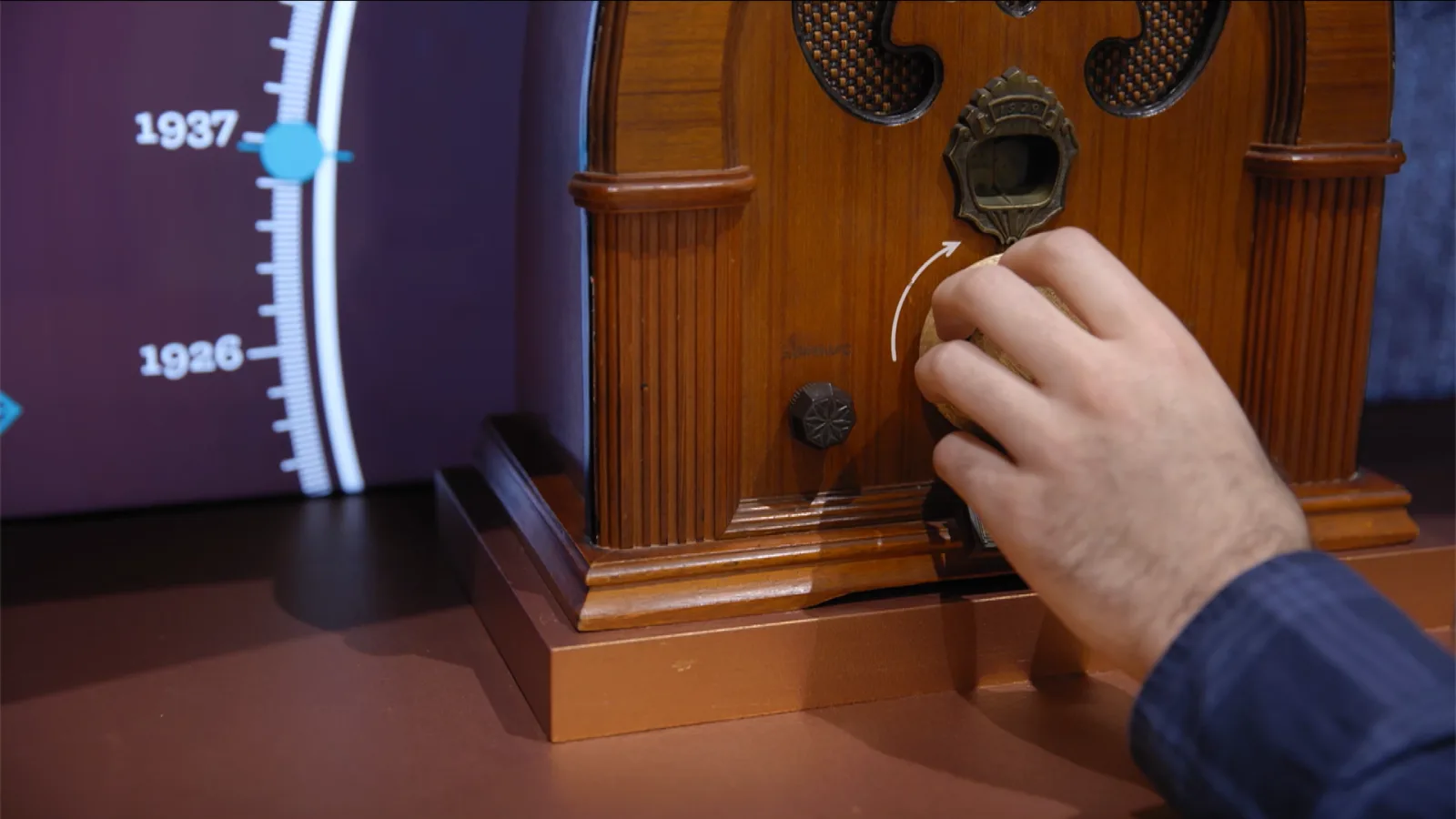
Imagine an antique radio in an exhibition. Instead of placing a touchscreen next to it with a timeline, the radio itself could become the interface. As a visitor turns the tuning dial, different frequencies could move them through different periods in history, playing voices, music and information connected to each moment seen on a regular screen behind the radio.
The object remains recognizable as part of the collection or exhibition language, but its familiar physical action becomes a way to explore digital content.
“This is not a technology per se This is a technique.”
Eduardo — We Are Interactive
That distinction is important.
A visitor does not necessarily need to know which sensor, microcontroller, software package or playback system makes the radio respond. What matters is that turning the dial feels appropriate to the object and reveals something worth discovering.
The interaction belongs to the story.
Physical and digital do not need to compete
Interactive museum experiences are sometimes discussed as if a project has to choose between traditional physical exhibition design and digital technology.
We Are Interactive prefers the space in between.
“We like to develop solutions that are not just touchscreens or completely digital, but also not totally physical”
Eduardo — We Are Interactive
A projection can add movement to a physical object without becoming the focal point itself. Audio can respond to where a visitor stands. A sensor can make an ordinary object trigger digital content. A wall can become interactive without visibly becoming a touchscreen.
The digital layer can be present without announcing itself.
This creates an important design possibility for museums. Technology can enhance the relationship between a visitor and the physical environment rather than pulling attention away from it.

More immersive does not mean more technologically complex
There is a common assumption that creating a more immersive experience requires adding more technology.
Eduardo’s answer to that is simple: it does not.
After years of watching visitors interact with installations, he has found that people respond to the experience itself far more than the complexity of the system behind it.
“Even with simple interactive things you can do, you can create very interesting and amazing experiences,” he says. “You don’t have to be deploying crazy-expensive, state-of-the-art technology to achieve that.”
A technically complicated installation can still be confusing, forgettable or disconnected from the exhibition.
A simple interaction can be memorable if it makes sense.
The measure of immersion should therefore be the visitor’s involvement, not the quantity of hardware in the room.
Design is what separates an experience from a tech demo
When asked what separates a cool technology demonstration from a genuinely good interactive experience, Eduardo gives a one-word answer:
“The design.”
A tech demo can be impressive. A visitor might wave at a sensor, see something react and enjoy the novelty for a few seconds.
But novelty alone does not necessarily communicate anything.
Good experience design gives the interaction a reason to exist. It connects the visitor’s action to a message, a story or a piece of content.
“With a good design, you can have an interesting experience and you can convey a message With a tech demo, you can have a small moment of engaging fun, but you’re not going to learn much from it.”
Eduardo — We Are Interactive
For a museum, that distinction is especially important.
The objective is rarely interaction for interaction’s sake. Museums are trying to communicate history, science, culture, art, identity or ideas. The interactive layer should make that content more accessible, engaging or memorable.
A better way to brief an interactive museum project
Instead of beginning a brief with a technology request, museums can start with a few experience questions.
What is this part of the museum trying to communicate?
Who will use it?
What should visitors do rather than simply look at?
What physical objects or architectural elements are already available?
Could those elements become part of the interface?
Should the interaction be individual or shared?
Should visitors receive information, create something, discover something or affect the environment?
What should they remember afterwards?
Only then does it make sense to ask what technology can support those goals.
The answer might be a touchscreen.
It might be projection, spatial audio, LiDAR, a depth camera, a physical control, a sensor hidden inside an object or a combination of several systems.
The point is not to avoid technology. It is to give technology a specific job.
The best technology can be almost invisible
There is a useful paradox in interactive experience design.
The more naturally the technology fits the interaction, the less visitors may think about the technology at all.
They turn the radio dial because it invites turning. They walk across the floor and see the environment respond. They touch a wall because something about the design tells them that they can.
The technical system disappears behind cause and effect.
For We Are Interactive, that is a stronger outcome than creating a space that simply looks technological.
“People become amazed with the experience itself, not the technology itself”
Eduardo — We Are Interactive
That does not make the technology less important. Building reliable interactive installations can involve sensors, real-time systems, custom software, calibration, audiovisual integration and significant technical problem solving.
It simply means those systems are working in service of something larger.
Design the memory, then choose the technology
Eduardo makes one final distinction that captures the philosophy clearly.
“Even if the technology fails, if the design is there, it’s going to be memorable. If the technology is working perfectly but the design fails, people are not going to remember it.”
For museums investing in interactive technology, that is a useful place to begin.
Do not ask how many screens the next exhibition needs.
Ask what visitors should remember.
Ask what action could help them understand the subject differently.
Ask whether the physical collection, architecture or environment can become part of that interaction.
Then decide whether the answer requires a screen at all.
Innovation is not about making a museum look more technological.
It is about finding better ways for people to connect with what the museum has to say.
Creating interactive museum experiences with We Are Interactive
We Are Interactive is a Portugal-based multimedia studio creating interactive installations and physical-digital experiences for museums, events, brands and cultural spaces.
The studio combines experience design with technologies including projection, LiDAR, depth sensing, real-time graphics, audio, AI, sensors and custom software. The technology changes from project to project because the experience comes first.