
Start with the goal, not the hardware
A client comes to an interactive studio with an idea for a wall, a museum exhibit, an event activation or an immersive space. It can be tempting to begin by choosing the most exciting technology available.
That is usually the wrong place to start.
At We Are Interactive, the first question is not whether an experience should use LiDAR, a depth camera or a touchscreen. It is what we want the visitor to gain from the experience.
Is it brand awareness connected to new technology? Is the heritage of the company or brand we want to reveal? How can we achieve the communication goal in the most engaging and attractive way is the first question we ask ourselves
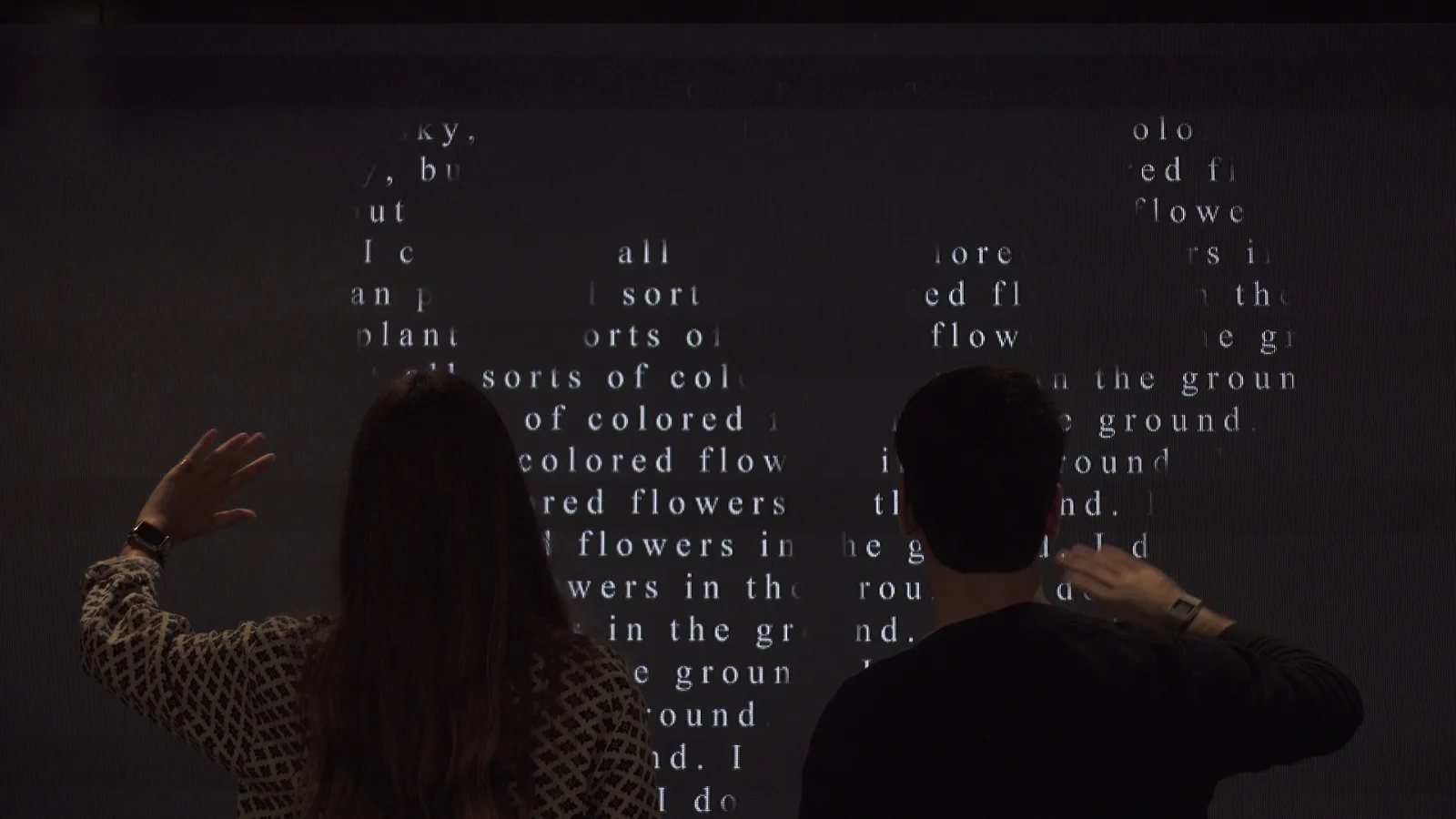
Should they read and select detailed information? Move their whole body through an experience? Draw across a six-metre wall? Throw an object at a target? Trigger something simply by entering a space?
Each of those interactions asks the system to understand something different.
Once that is clear, the technology decision becomes much easier.
When a touchscreen is the right choice
Touchscreens are familiar for a reason. They are precise, responsive and well suited to interactions where visitors are close to the display.
If an experience asks someone to browse detailed information, read small text, select from a menu or interact with a conventional interface, a touchscreen can be the simplest and strongest solution.
Eduardo from We Are Interactive describes the distinction in practical terms: if visitors need detailed information and precise close-range interaction, touchscreens are often preferable to LiDAR.
The limitation appears when the experience needs to become much larger.
A standard touchscreen is still a screen with touch hardware built into it. Once an installation expands into a large LED wall, projection surface, floor or room-scale experience, other sensing technologies can offer far more freedom.
When LiDAR makes more sense
LiDAR becomes especially useful when an installation needs to understand position across a large physical area.
The technology emits invisible laser points and measures the light that returns. Those distance measurements can be translated into positions and coordinates that interactive software can use.
In practice, that means a large wall or floor can behave like an interactive surface without containing conventional touch hardware.
“We can turn any surface, be it a wall or a floor, into an interactive space”
Eduardo — We Are Interactive
A visitor can move a hand across a large display and create visual feedback. A projected floor can react as people walk through it. Light can follow a visitor because the system knows where that person is. Even an object crossing the detection plane, such as a ball thrown at a wall, can become an input.
For experiences built around scale, movement and spatial interaction, this is where LiDAR becomes particularly valuable.
When a depth camera is the better tool
Depth-sensing cameras solve a different problem.
Rather than treating a large surface primarily as a coordinate plane, a depth camera can be useful when the visitor’s body itself is the input.
We Are Interactive has used depth-sensor cameras for experiences where a person’s silhouette is transformed into another visual element. A visitor’s body might appear as fire, water or an abstract digital form, for example.
In that kind of installation, understanding the shape and movement of the person is central to the concept.
This difference can be summarized simply:
Touchscreens are strong when the system needs precise input on a display.
LiDAR is strong when the system needs to understand position across a large surface or space.
Depth cameras are strong when the system needs to understand a person’s body, silhouette or spatial movement.
Those categories can overlap, but identifying what information the experience actually needs is a useful starting point.
A real example: why We Are Interactive chose LiDAR instead of a depth camera
The distinction became important during an interactive installation We Are Interactive developed for an energy-company event.
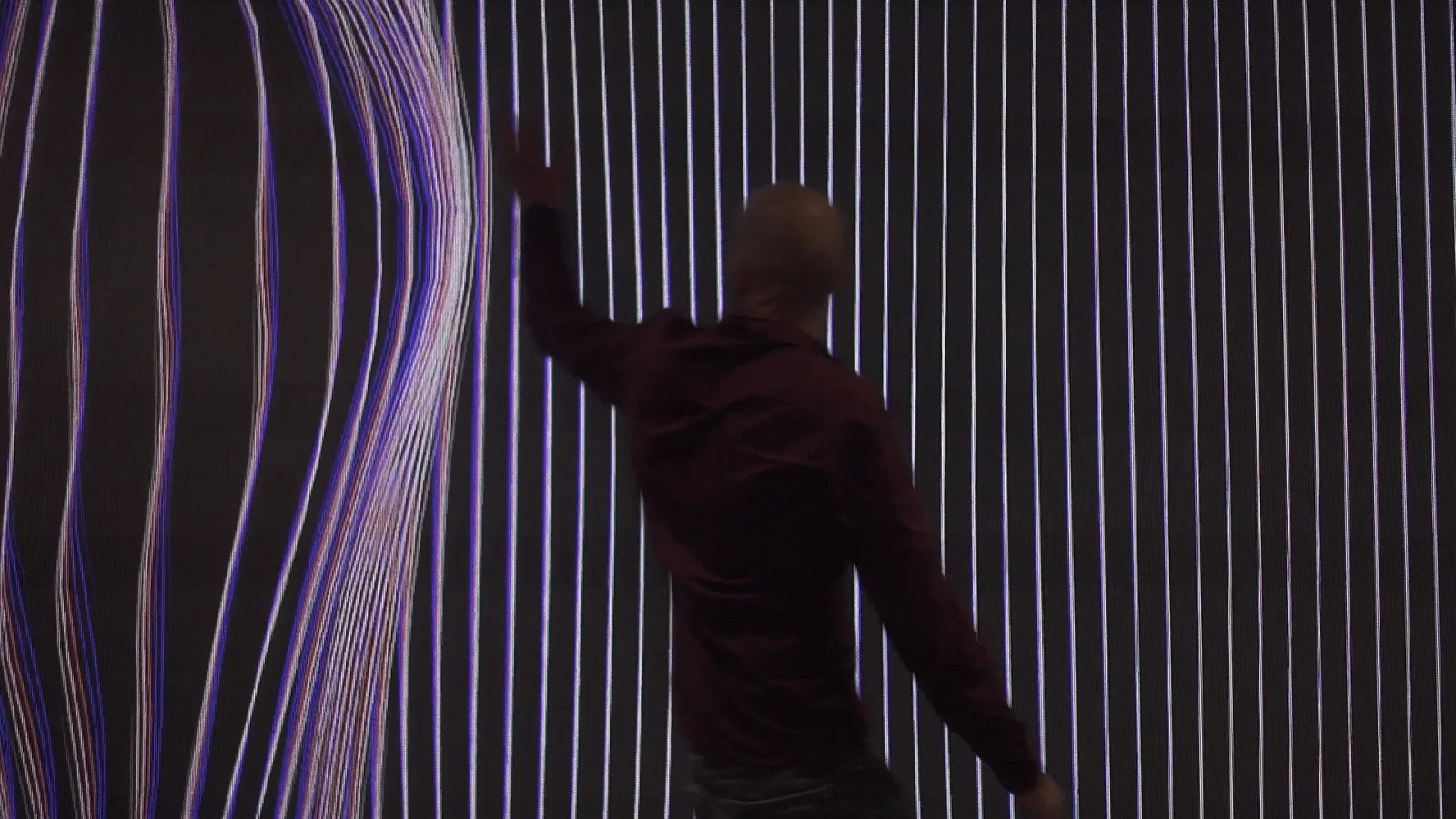
The concept used a 3 × 6 metre LED wall. Visitors moved their hands across the display to create light strokes, which were then interpreted through AI and transformed into sustainability-inspired imagery.
The team initially considered depth-sensing cameras because they had already used them successfully in other interactive experiences.
But this installation needed different information.
“We did not want to detect the person’s movement as a silhouette We wanted to detect what the person intended to draw.”
Eduardo — We Are Interactive
A depth camera could understand the visitor’s body, but the critical input was the intended drawing position across the wall. The system needed to know where the visitor was interacting on a very large surface.
For that reason, We Are Interactive chose rotating LiDAR.
The sensor scanned across the wall and translated the visitor’s interaction into X and Y coordinates. Those coordinates powered the drawing system, allowing the visual response to appear where the visitor expected it.
Without that relationship between gesture and position, the experience would have felt disconnected.
Scale changes the technology decision
One of the clearest differences between these technologies is scale.
For a small information display, installing LiDAR would often introduce complexity without adding meaningful value. A touchscreen already provides the precision the interaction requires.
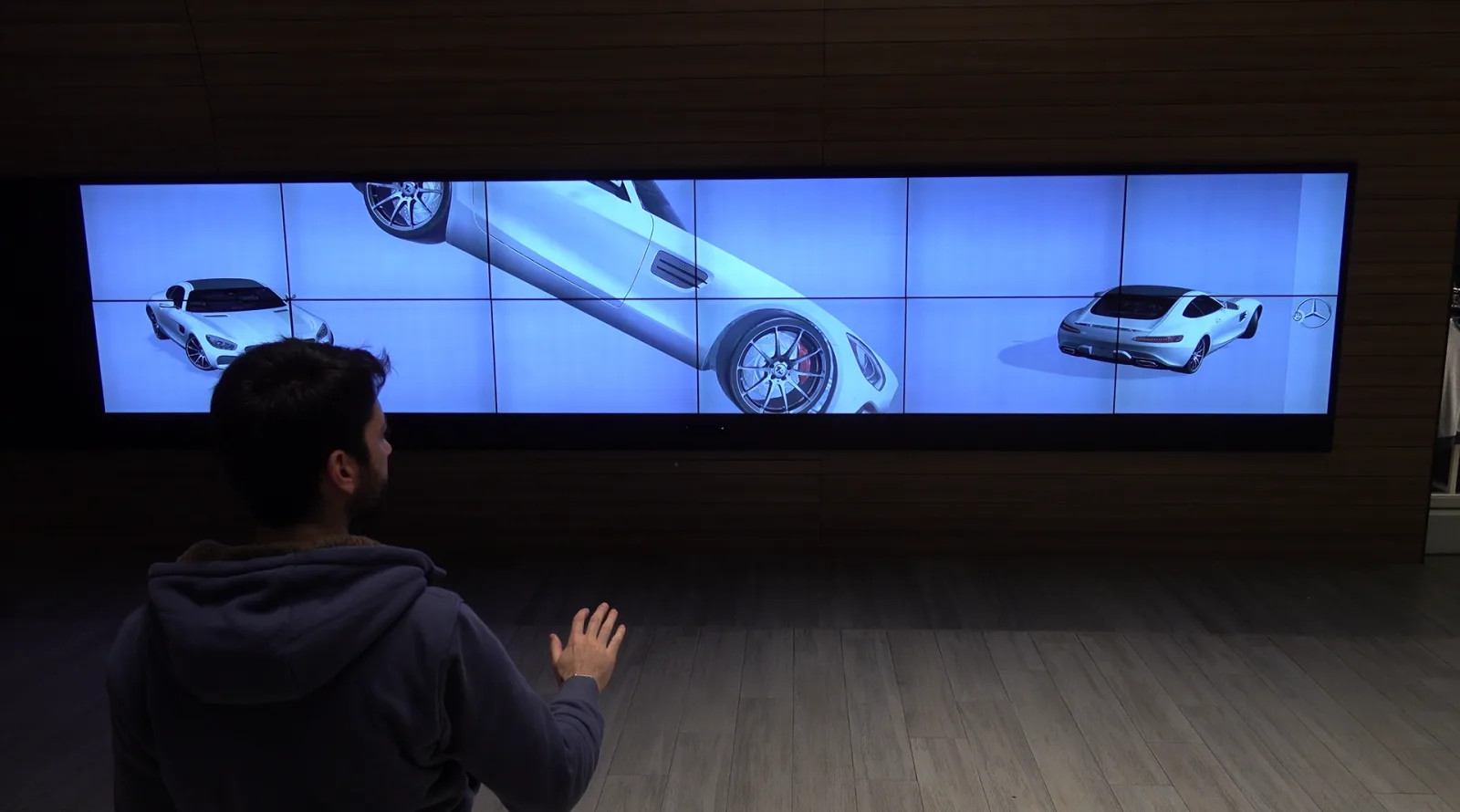
For a six-metre LED wall, the calculation changes. The display itself does not need to contain touch hardware if an external sensing system can accurately map interaction across it.
LiDAR can also extend beyond the wall entirely. If a sensor is monitoring a larger area, the installation can respond to people moving through the space rather than only when they reach a screen.
This is why technology selection should happen after the physical experience is understood.
How large is the interaction area? How far will visitors be from it? Are they touching something, moving through something or simply entering a defined zone?
The answers determine what the system needs to sense.
Accuracy and responsiveness matter
An interactive experience depends on visitors believing that their actions caused the response they see.
If someone touches one area of a wall and the visual appears somewhere else, that relationship breaks. If a person moves and the installation responds noticeably later, it can feel less like interaction and more like a delayed effect.
For the 3 × 6 metre LED-wall project, We Are Interactive ran LiDAR detection at approximately 15 frames per second. For the speed and type of movement involved, that was enough to create a fluid response.
The goal was not to maximize a technical specification. It was to reach the level of responsiveness the experience required.
That same principle applies across technologies. A touchscreen, LiDAR system or depth camera should be evaluated according to the interaction it needs to support, not simply by which device has the most impressive specifications.
The physical environment matters too
Technology that works perfectly in one environment may be the wrong choice in another.
For LiDAR, the shape of the surface and environmental conditions need to be considered. A flat wall is well suited to creating a touch-like detection plane. A heavily curved or irregular surface can make that approach less appropriate.
Direct light can also create challenges. Outdoor installations introduce additional factors such as temperature, rain and the weather rating of the sensor itself.
The LiDAR unit used by We Are Interactive in the featured project, for example, is not IP67-rated and is therefore not intended to be exposed to rain.
Depth cameras and touchscreens have their own environmental requirements. Camera placement, viewing angle, lighting, visitor distance, display construction and the expected number of users can all affect the final choice.
A simple framework for choosing the technology
Before selecting hardware for an interactive installation, We Are Interactive effectively works through three questions.
1. What should the visitor do?
Are they reading, selecting, drawing, walking, moving their body, throwing an object or simply entering a space?
2. What does the system need to understand?
Does it need a precise touch point, an X and Y position, distance, a person’s silhouette or broader movement through a room?
3. Where does the experience need to work?
Consider the size and shape of the surface, lighting, weather exposure, mounting options, visitor distance, crowd behaviour and the audiovisual system already present.
Those answers create a much better technology brief than starting with, “We want to use LiDAR,” or, “We want an AI experience.”
The technology becomes a response to the design problem.
Technology should disappear into the experience
For Eduardo, years of watching people use interactive installations have reinforced one lesson: visitors are more impressed by the experience than by the technology behind it.
That is why the best choice is not automatically the newest, most expensive or most technically complex option.
Sometimes a touchscreen is exactly right. Sometimes a depth camera allows the body to become part of the visual. Sometimes LiDAR turns an enormous passive surface into something responsive.
And sometimes the best solution is much simpler than any of them.
“You don’t have to be deploying crazy-expensive, state-of-the-art technology to achieve that”
Eduardo — We Are Interactive
The strongest interactive installations make the technology serve the idea so naturally that visitors do not need to think about the sensor at all.
They simply understand what they can do, do it, and get a response worth remembering.
Choosing technology for your next interactive installation
We Are Interactive is a Portugal-based multimedia studio creating custom interactive experiences for events, museums, brands and physical spaces. The studio works across experience design, LiDAR, depth sensing, projection, real-time graphics, AI, sensors and custom software.
If you have an idea for an interactive installation but do not yet know which technology it requires, that is not a problem. Defining the visitor experience first is often the better starting point.