
The brief: make sustainability something people could interact with
For an energy-company event, the challenge was not simply to put content on a large screen. The goal was to give visitors a way to participate in the experience and connect their own movements to a visual interpretation of sustainability.
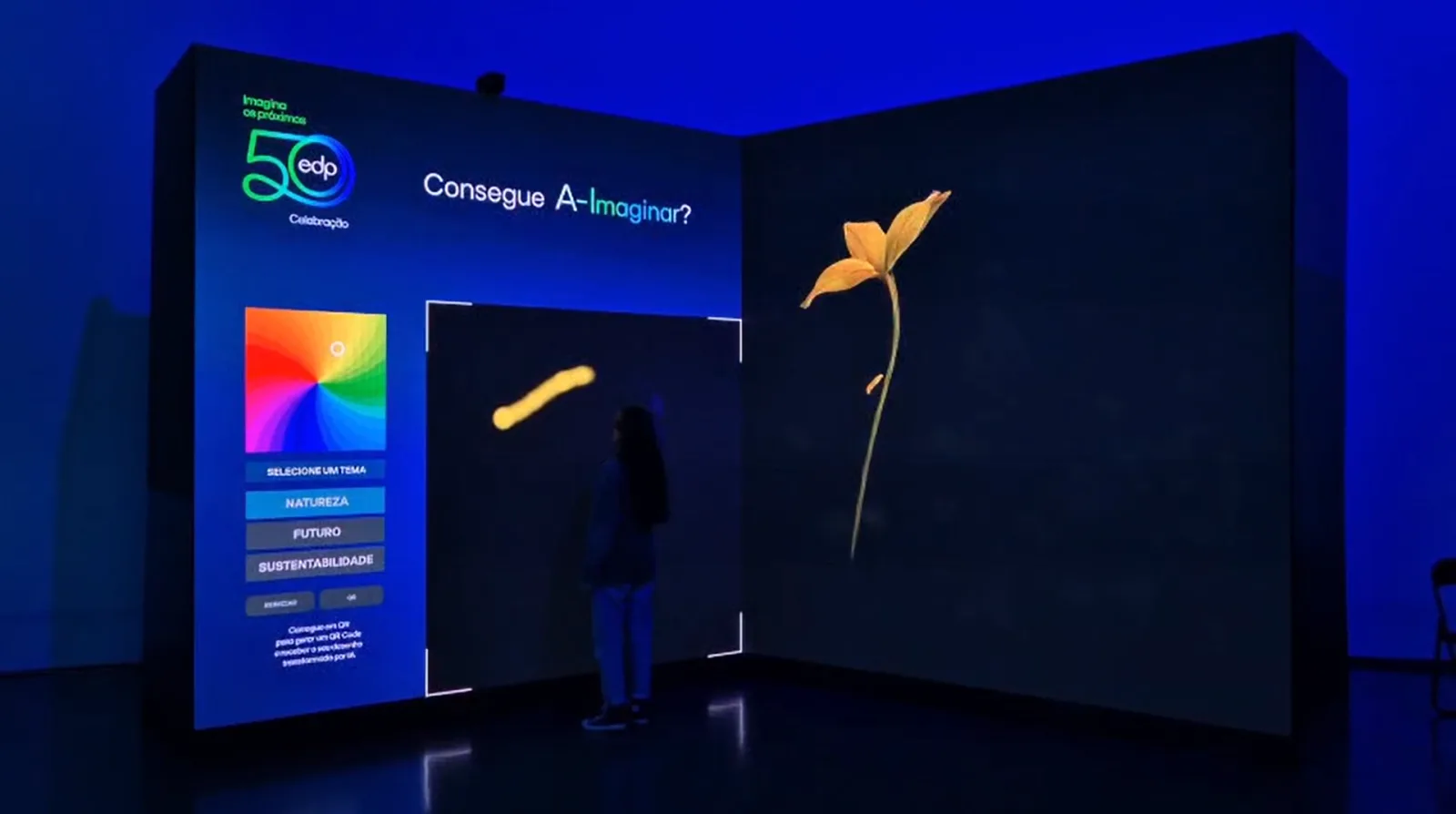
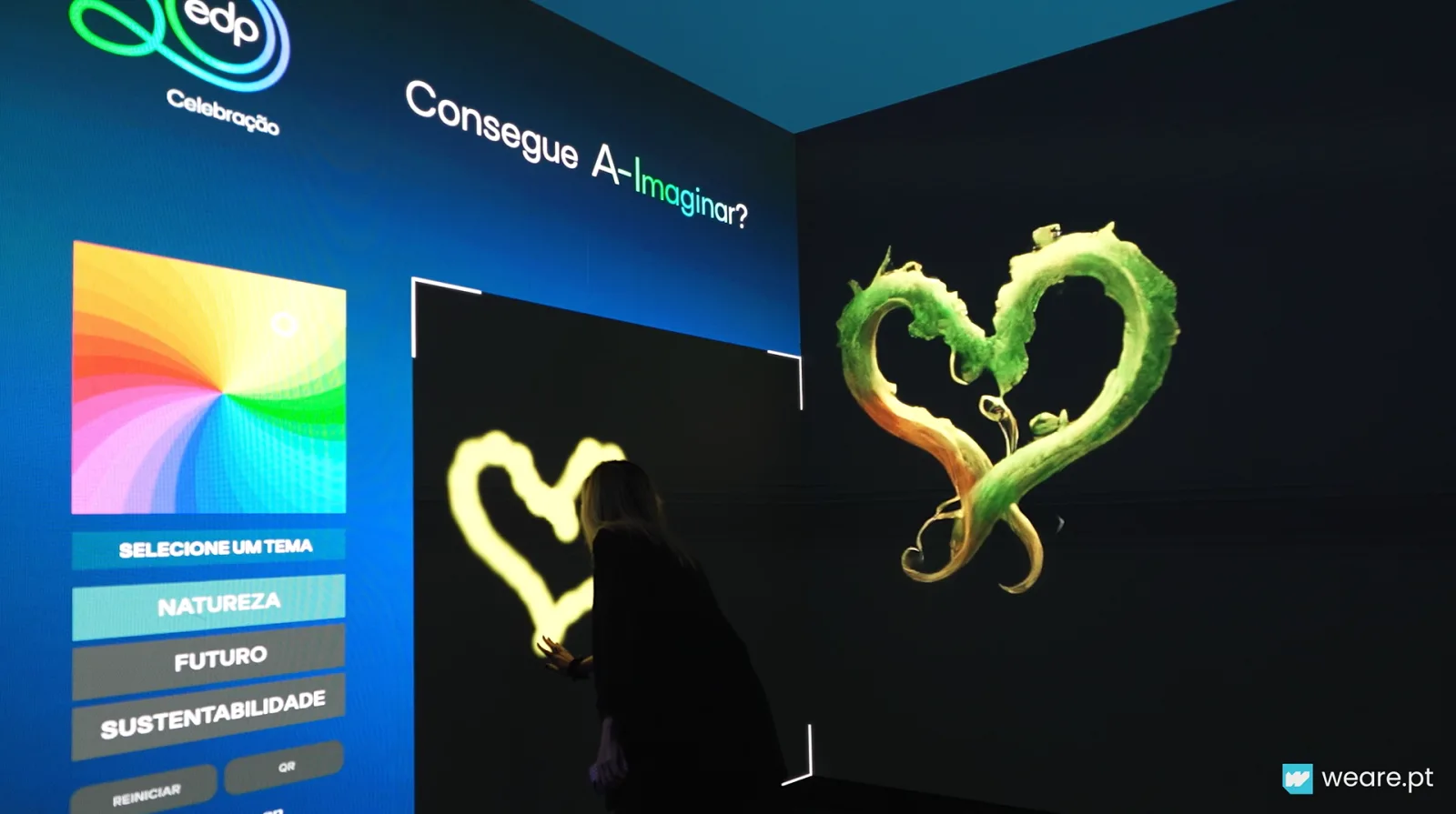
The final installation used a 3 × 6 metre LED wall as its canvas. Visitors could move their hands across the display to create lines of light, then watch those simple gestures transform through AI into organic imagery such as leaves and flowers.
The idea was proposed by We Are Interactive as a way of turning a display normally used for passive communication into something visitors could actively shape.
“We wanted people to be able to see that they can create beautiful things”
Eduardo — We Are Interactive
The concept: from a simple movement to a finished image
The experience was designed around a simple cause-and-effect relationship.
A visitor approached the LED wall and moved a hand across its surface. Their movement immediately appeared as streaks of light, giving them direct visual feedback that the installation was responding to them.
At the same time, the system took those marks and used AI to reinterpret them as a more developed visual composition. Simple lines became patterns of leaves, flowers and other imagery connected to the sustainability theme.
The visitor could see both parts of the process. On one side was the movement they had created. On the other was the AI interpretation that grew from it.
This was important to the concept. The AI was not there as a disconnected novelty. The visitor’s own action remained visibly connected to the result.
“We wanted the interaction to feel like magic People were mesmerized by the results.”
Eduardo — We Are Interactive
Why LiDAR was the right interaction technology
Making a six-metre-wide LED wall respond accurately to a person’s hand movement required a sensing system separate from the display itself.
We Are Interactive considered depth-sensing cameras, a technology the studio has used in other interactive projects. In those experiences, a camera can detect the visitor’s body or silhouette and use that shape as the input.
That was not what this project needed.
“We did not want to detect the person’s movement as a silhouette We wanted to detect what the person intended to draw.”
Eduardo — We Are Interactive
For this installation, the important information was the position of the visitor’s interaction across the wall. LiDAR was better suited to turning that large surface into a coordinate-based interaction area.
A rotating LiDAR sensor was installed close to the LED wall and configured to scan across the surface. When a visitor’s hand intercepted the detection plane, the system could determine where that interaction happened and translate it into X and Y coordinates.
Those coordinates became the input for the drawing experience.
Building the system
The interactive layer was built by We Are Interactive.
The physical system consisted of the LED wall supplied at the venue, a rotating LiDAR sensor and a computer running the custom experience. On the software side, the team combined multiple tools, including TouchDesigner and Python scripts, to connect the sensor data, drawing interaction, AI processing and final visual output.
The flow looked roughly like this:
1. The visitor moved a hand across the LED wall.2. The LiDAR detected the position of that movement.3. The sensor data was translated into X and Y coordinates.4. The custom application turned those coordinates into responsive light strokes.5. The visitor’s drawing was passed into the AI component.6. The AI interpreted the input as sustainability-inspired imagery.7. The result appeared as part of the live experience on the LED display.
The installation therefore combined two different types of responsiveness. First, there was the immediate response of the light following the visitor’s movement. Then there was the transformation of that movement into a new visual result.
That first layer matters. If an interactive system waits for AI processing before acknowledging the visitor, the experience can feel disconnected. Here, visitors could immediately see that the wall had registered their action while the more complex interpretation happened as part of the wider experience.
Making a large LED wall feel responsive
Responsiveness is one of the details that separates an interactive surface from a screen that merely appears to react.
For this project, the LiDAR system was running at approximately 15 detection frames per second. That was sufficient for the type and speed of movement visitors were making across the wall.
The goal was not to maximize a specification for its own sake. It was to make the visual response feel connected to the person’s gesture.
Without LiDAR, the team could have attempted the same concept using depth cameras. But accurately mapping a visitor’s intended drawing position across the wall would have been more difficult.
If the visitor moves a hand in one place and a light stroke appears somewhere noticeably different, the relationship between action and result breaks down.
“It could feel like an unresponsive system just creating some light streaks in different areas of the screen”
Eduardo — We Are Interactive
For an experience built around personal creation, that accuracy was essential.
On-site setup: the sensor has to agree with the screen
Once the LED wall was installed at the venue, We Are Interactive brought in the computer and LiDAR system and positioned the sensor as close as practical to the display without interfering with it.
The relationship between the LiDAR and the screen then had to remain fixed.
If the sensor rotates, shifts or vibrates independently from the display, its coordinates no longer correspond to the same points on the screen. The experience would then need to stop and be recalibrated.
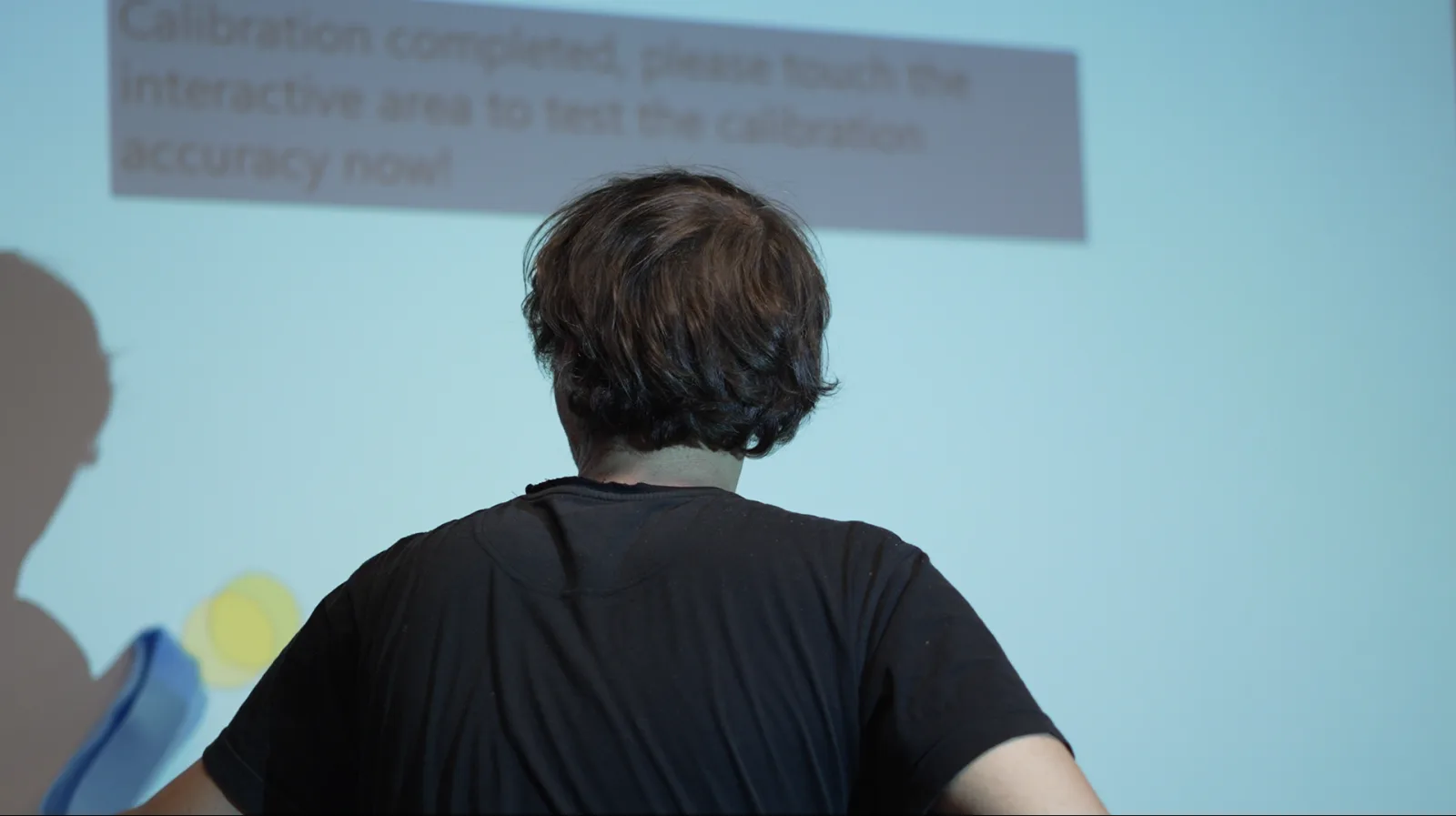
Once the sensor was securely positioned, calibration took up to around 30 minutes.
The LED wall itself was a heavy, stable structure, which made it well suited to the installation. The same principle can be applied to projection surfaces and other large displays, but the physical relationship between sensor and surface always needs to be considered.
The unexpected AV challenge: resolution is not the whole picture
One of the most useful lessons from the project had little to do with LiDAR.
When an interactive studio is integrating its system with audiovisual equipment supplied by another company, asking for the LED screen’s resolution is not always enough.
The team also needs to know the pixel space being delivered by the AV system and where the physical display sits within it.
“Besides the resolution of the screen, it’s important that the AV company gives you the pixel space that you’re actually going to be using”
Eduardo — We Are Interactive
That information matters because the interactive application is mapping positions to pixels. If the software is programmed for one coordinate space while the AV system places the visible screen inside another, the interaction can become misaligned.
For a conventional video, that might be an inconvenience. For an interactive wall, it can affect the experience itself.
The lesson for future installations is straightforward: confirm the resolution, confirm the complete pixel space, and confirm how the display is mapped inside it before arriving on site.
This is the kind of implementation detail that is easy to overlook when an experience crosses several disciplines. The LiDAR, custom software, AI system and audiovisual hardware may all work correctly on their own. The installation only works when they work correctly together.
What happened when visitors used it
Once the system was running, visitors quickly understood that the LED wall was not behaving like a normal event display.
Their movements produced immediate visual feedback, and the AI transformation gave them a result that was personal to their interaction.
At the end of the experience, the system generated a QR code so visitors could keep the image they had helped create.
But Eduardo noticed another behaviour that was just as revealing.
People were filming themselves using the installation.
Although they could already take the finished image away digitally, visitors wanted to capture the act of interacting with it. The experience itself had become something worth recording.
“I think that people taking videos of themselves using it was the biggest success It’s something they want to relive afterwards.”
Eduardo — We Are Interactive
For an event installation, that distinction matters. The output was not the only souvenir. The interaction became part of the content visitors wanted to keep and potentially share.
The result: a passive display became part of the experience
The project started with a technology that appears at events everywhere: a large LED wall.
What changed was the role it played.
Instead of asking visitors to stand in front of a screen and watch content, the installation gave them a direct way to affect what appeared on it. LiDAR provided the large-scale interaction layer. Custom software connected that movement to the visuals. AI transformed the visitor’s input into something they could not predict in advance.
None of those technologies needed to be the subject of the experience.
The subject was the visitor’s action and what it could become.
That reflects a broader principle in how We Are Interactive approaches interactive installations. Technology is selected after the desired experience is understood.
In this case, the team needed a six-metre surface to understand where someone intended to draw. That made LiDAR useful. The concept needed those simple gestures to evolve into richer sustainability imagery. That made AI useful.
The technology had a job to do.
And when it worked together, a screen that would normally display content became something people could create with.
Planning an interactive installation?
We Are Interactive is a Portugal-based multimedia studio creating custom interactive experiences for events, museums, brands and physical spaces. The studio combines experience design with technologies including LiDAR, sensors, real-time graphics, projection, AI and custom software.
If you are planning an experience and are not yet sure what technology it needs, that is usually the right place to start. Define what you want people to do, feel or understand first. The technical system can follow.